Our Response to Change is Neurological
I've worked in many organisations that have been undergoing change and have often wondered what's going on inside of us that makes change seem so daunting. Well, now I know! I've been reading a superb book by David Rock "Your Brain At Work" and he explains in easy to understand language that the brain is quite simply a prediction machine.
Certainty creates predictability and this predictability is one of the fundamental pillars to our human intelligence. I always knew that uncertainty was probably one of the key reasons why change can create a strong response and it seems it's because of our need for predictability. After all, if our brain functions by comparing what's happened to patterns stored in our memories, we can make sense of our world.
Making Sense Of Change
We use all of our senses to interpret and understand what's going on around us. We use what we've heard and seen to predict what might come next. In his book, Rock refers to an email that you've probably seen - the one where only the first and last letter of each word is correct. And yet, we can still read the email. The brain puts in the missing text based on what we've seen and heard in the past. Our ability to create patterns and predict what will happen next explains why certainty is so important. We derive comfort from being certain about what we can predict.
It's no wonder people become disorientated when organisations announce changes and yet can't be specific about what the changes might mean. In one fell swoop they've taken away both predicatability and certainty - a very uncomfortable place to be in.
Why Do People Get Upset When Things Change?
Again , at an intuitive level you can see why this might be the case. After all, if you're not feeling very comfortable then you're going to be a bit upset. There is a neurological reason for this as well. If we imagine that certainty is like a sugar rush for the brain - it has a craving for certainty to make it feel comfortable. Without the 'certainty rush' the limbic region of the brain gets stimulated.
In simple terms the limbic system contains all the areas of the brain that are responsible for our emotions; how we feel about things, and how we decide what is positive, to move towards and what is negative, to stay away from.
By over stimulating the limbic system, fear, feelings of insecurity, loss, sadness and sometimes panic click into action before we've had chance to really understand what that's about.
Is Uncertainty Always Negative?
Rock explains that even mild uncertainty can stimulate the amygdala - part of the limbic system. In an organisational setting, mild uncertainty might translate as what will happen if you don't achieve your objectives e.g. you won't get that promotion you've been working hard for.
As humans we do need some uncertainty to motviate us into action - the trick is to practise listening to what's happening inside and developing strategies for harnessing that mild uncertainty. After all, it usually holds a message for us to take action.
As a coach, some of the techniques I use with clients are reframing and identifiying choices. That way you are more likely to recapture a sense of control and so create a degree of predictability back into the proceedings.
How Can We Better Cope With Change?
There are two types of change and for ease we'll call them - transitional and transformational. Just reading those names which one creates a greater feeling of uncertainty? I am guessing it's going to be transformational. Am I right?
Transformational change is therefore going to create more challenges - a heady mix of unpredictability and loss of control. Getting clear what will stay the same i.e. be predictable, is probably one of the key elements of helping people come to terms with this type of change. And also being clear about what is uncertain and create some element of reframing and choice around that uncertainty.
Transitional change is all about finding ways of working new habits into existing habits or looking at existing habits in a different way, reframing them and creating choices.
So if you're looking to make any changes bear in mind that the neurological make up of your brain will be a key player in the success of that change. Helping it find ways of achieving predictability will serve you well in changing a habit of a lifetime!
Monday, 11 July 2011
Tuesday, 19 April 2011
How I Remembered That Change Is Personal
Change is Personal
Last month I changed my car. Why am I telling you this? Well, as you know I specialise in behaviour change and have experienced a lot of change in organisations and seen and heard first hand how it can affect people.
So you’d think that I would know how people process change and what might happen as they transition through the process. Well, even with all my knowledge and experience it was only when I made the decision to change my car – a mazda RX8 - that I realised how emotionally attached I was. I know, emotional attachment to a car sounds bizarre.
What’s Important To Me?
It all started back in January this year when I was reminded of a technique to elicit clients’ values. I watched as the process was demonstrated on a willing volunteer. As they went through the process I started to think about what I value in a car – and more importantly why I value my car.
My Mazda was quirky – the back doors opened the other way to normal, it was an unusual shape, the lights were like eyes, and it had a potential speed of 140mph (I drove it on a track day at high speed !). In short, my car was an extension of my personality: quirky, energetic and adventurous. I sometimes joked that if I ever needed money the car would be the last thing I would sell (apologies to my husband and cat!).
On the downside it drank petrol which when I bought it wasn’t so bad – around 90p a litre. But with petrol prices well beyond the pound a litre limit and still rising I knew that the day was coming soon when I would have to say goodbye to my Maz!
What Triggered The Change?
Mid January my road fund licence was due and then I had to have the car serviced. Being a few hundred quid lighter I decided that now was the time to change! Armed with last year’s valuation in mind I went to see the sales man and asked him for a price. Thud! My expectations were dashed and then crushed – the car had lost £3k in the last year and was depreciating at an alarming rate.
Now I’m not the sort of person who cries easily – but when I heard the price the salesman was willing to give me I really had to fight back the tears. Biting my lip I asked to test drive another car to see what it was like. I was now really worried about whether I could actually afford to change my car after all.
Processing Time – Emotional Responses Kicked In
Leaving the show room that Friday night my heart felt heavy and I was in denial. “Surely he had got it wrong – my car must be worth more than that?” I was angry and upset – it was as if he’d insulted me personally.
I didn’t sleep much that night and got up at 5.45am on the Saturday morning to surf the web to back up my beliefs about my car. Glass’s guide confirmed the price I’d been given was in range. Shock! Horror!
By mid-morning on the Saturday my solutions brain had kicked in and I was on the phone trying to get hold of a friend who owned the same type of car I’d test driven the night before.
It was Sunday afternoon when I eventually got hold of her. I wanted to know how long she’d had the car, what she thought about it, how well it was running and so on. I wanted to know everything if I was going to get rid of my beautiful Maz. Would this new car be good enough?
Imagining a Different Future
As I put the phone down I allowed myself to imagine what it would be like to be without Maz. She’d recommended the garage where she’d got her car I resolved to call them on the Monday.
By Tuesday morning I was sat opposite another salesman at the garage recommended by my friend. I’d explained to him my story and how upset I was that Maz had been so mistreated. He was sympathetic and went off to get a valuation on my car. It seemed hours later when he returned but I suspect it was only about 10 minutes.
“Well, I can tell you that we think your car is worth more than what you’ve been offered.” Within 30 minutes he’d talked me through the buying and financing process and I was pretty much sold. I just needed to go away and think it through now that I’d heard all the facts.
Taking the First Brave Step to a New World!
By the Wednesday I’d ordered my new car and mentally started the process of letting go of my little Maz.
I realise now that I was going through the transition process of change. At a subconscious level my old car represented my old life when I worked in corporate. I thought that I’d made the transition a long time ago when I set up Ascent2Change in 2005 – but I realise that I was still holding onto something.
My new car is cute, fun and cool (according to my nephew!) and represents a different part of my life now. It’s also more environmentally friendly, costs nothing in road fund licence and has a roof that lets you run the breeze as you’re driving along. It’s exciting and new and the blue sky colour represents my creative, big picture perspective on life.
Being A Different Me
I’ve now made the transition and moved into a different phase. It’s taken a long time and I didn’t even know that it was taking time!
So when you are working with change in any setting whether it’s at home or work remember that we all process change in different ways and in different time frames; often without being consciously aware of it.
Change is a process of transition. It’s not like having an on and off switch and cannot be ticked off a list like a task – I found that out recently in a way I wasn’t expecting.
We experience change every day of our lives; we’re just not always aware of it. So if you’re involved in ‘implementing’ change in an organisation, remember that your working with human beings and we all process change in different ways.
Last month I changed my car. Why am I telling you this? Well, as you know I specialise in behaviour change and have experienced a lot of change in organisations and seen and heard first hand how it can affect people.
So you’d think that I would know how people process change and what might happen as they transition through the process. Well, even with all my knowledge and experience it was only when I made the decision to change my car – a mazda RX8 - that I realised how emotionally attached I was. I know, emotional attachment to a car sounds bizarre.
What’s Important To Me?
It all started back in January this year when I was reminded of a technique to elicit clients’ values. I watched as the process was demonstrated on a willing volunteer. As they went through the process I started to think about what I value in a car – and more importantly why I value my car.
My Mazda was quirky – the back doors opened the other way to normal, it was an unusual shape, the lights were like eyes, and it had a potential speed of 140mph (I drove it on a track day at high speed !). In short, my car was an extension of my personality: quirky, energetic and adventurous. I sometimes joked that if I ever needed money the car would be the last thing I would sell (apologies to my husband and cat!).
On the downside it drank petrol which when I bought it wasn’t so bad – around 90p a litre. But with petrol prices well beyond the pound a litre limit and still rising I knew that the day was coming soon when I would have to say goodbye to my Maz!
What Triggered The Change?
Mid January my road fund licence was due and then I had to have the car serviced. Being a few hundred quid lighter I decided that now was the time to change! Armed with last year’s valuation in mind I went to see the sales man and asked him for a price. Thud! My expectations were dashed and then crushed – the car had lost £3k in the last year and was depreciating at an alarming rate.
Now I’m not the sort of person who cries easily – but when I heard the price the salesman was willing to give me I really had to fight back the tears. Biting my lip I asked to test drive another car to see what it was like. I was now really worried about whether I could actually afford to change my car after all.
Processing Time – Emotional Responses Kicked In
Leaving the show room that Friday night my heart felt heavy and I was in denial. “Surely he had got it wrong – my car must be worth more than that?” I was angry and upset – it was as if he’d insulted me personally.
I didn’t sleep much that night and got up at 5.45am on the Saturday morning to surf the web to back up my beliefs about my car. Glass’s guide confirmed the price I’d been given was in range. Shock! Horror!
By mid-morning on the Saturday my solutions brain had kicked in and I was on the phone trying to get hold of a friend who owned the same type of car I’d test driven the night before.
It was Sunday afternoon when I eventually got hold of her. I wanted to know how long she’d had the car, what she thought about it, how well it was running and so on. I wanted to know everything if I was going to get rid of my beautiful Maz. Would this new car be good enough?
Imagining a Different Future
As I put the phone down I allowed myself to imagine what it would be like to be without Maz. She’d recommended the garage where she’d got her car I resolved to call them on the Monday.
By Tuesday morning I was sat opposite another salesman at the garage recommended by my friend. I’d explained to him my story and how upset I was that Maz had been so mistreated. He was sympathetic and went off to get a valuation on my car. It seemed hours later when he returned but I suspect it was only about 10 minutes.
“Well, I can tell you that we think your car is worth more than what you’ve been offered.” Within 30 minutes he’d talked me through the buying and financing process and I was pretty much sold. I just needed to go away and think it through now that I’d heard all the facts.
Taking the First Brave Step to a New World!
By the Wednesday I’d ordered my new car and mentally started the process of letting go of my little Maz.
I realise now that I was going through the transition process of change. At a subconscious level my old car represented my old life when I worked in corporate. I thought that I’d made the transition a long time ago when I set up Ascent2Change in 2005 – but I realise that I was still holding onto something.
My new car is cute, fun and cool (according to my nephew!) and represents a different part of my life now. It’s also more environmentally friendly, costs nothing in road fund licence and has a roof that lets you run the breeze as you’re driving along. It’s exciting and new and the blue sky colour represents my creative, big picture perspective on life.
Being A Different Me
I’ve now made the transition and moved into a different phase. It’s taken a long time and I didn’t even know that it was taking time!
So when you are working with change in any setting whether it’s at home or work remember that we all process change in different ways and in different time frames; often without being consciously aware of it.
Change is a process of transition. It’s not like having an on and off switch and cannot be ticked off a list like a task – I found that out recently in a way I wasn’t expecting.
We experience change every day of our lives; we’re just not always aware of it. So if you’re involved in ‘implementing’ change in an organisation, remember that your working with human beings and we all process change in different ways.
| Reactions: |
Tuesday, 15 March 2011
How Do You Behave In A Team?
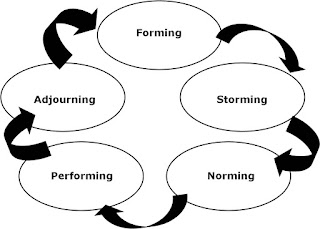
Teams exist to get a task or tasks done – their sole purpose is achieving outcomes. This might seem straightforward enough but not all teams work together well.
The model above on team development and behaviour was developed by Dr Bruce Tuckman in 1965 to help understand what high performing teams need to do in order to achieve their outcome. Adjourning was added in c1975 and recognises that closure is needed to move from performing in one team to forming another team.
So let’s have a look at each stage in detail
Forming
When a group of people come together they are not yet a team. Forming the team, getting the right people in the team and making sure they have the right roles is really crucial if the group is to become a team that achieves its goal.
But that’s not the only time a team forms – when members leave and new members join the team, the team has to go through the same process of welcoming the new member into the team, and showing them how things are done around here!
This is also the stage where the end goal or outcome is discussed for the first time.
So the forming stage occurs when teams come together for the first time or when something changes in the team.
Storming
This is always the interesting stage in team development because it’s about testing the boundaries and ground rules of the team. So you might experience competitiveness among team members and sometimes out and out conflict. Jockeying for position can also accompany this stage in the team development along with game playing and ‘showing off’.
Teams that go on to achieve great things develop a way of managing this conflict so that it becomes a healthy way of airing differences and getting things out in the open so that they can discuss and move on. Trust is a key success factor in whether or not the team will move on.
In dysfunctional teams, they never move beyond this stage usually because there is insufficient trust and lack of shared goal.
So storming is about laying your cards on the table and really getting into the nitty gritty around the shared goal.
Norming
On the surface this sounds pretty bland and inane but it’s surprising how many teams never reach this stage. Having gone through working out each other and getting all the issues on the table a team that can pretty much function day to day without too much hassle has reached a stage of balance and functions well.
They’ve worked out how to get along and all know what their role is within the team and know what tasks they’ve got to achieve. They are also pretty good at decision making through agreement and discussion. BUT there is a danger that if a team stays too long at the ‘norming’ stage there is a danger that complacency will creep in and motivation will wane.
So norming is about finding a balance without becoming complacent.
Performing
This is the stage that all teams want to reach because it’s here they’re getting great results and are working well together. This is the stage when they have become a real team. The challenge at this stage is continuous improvement so that the team can continue to get great results.
Truly brilliant teams know how to add a bit of frisson into the mix so that they constantly challenge the team with new ideas and different perspectives to bolster motivation.
Adjourning
This stage was added later to recognise that teams do not last forever and in an age of constant flow and flux, organisational change is perhaps the only constant. Recognising the team’s achievements both what’s gone well and what could have gone better is part of the letting go process. Without this formal stage of ‘saying goodbye’ forming new teams becomes more challenging.
Adjourning is a way of ‘grieving’ the old team and enabling a new journey with the next team. This is an important part of the process and very often missed in organisations. No wonder people still hark back to the ‘good old days’ when they were in team XYZ!
So there you have it, a simple yet effective model to understand what happens in teams and maybe some pointers as to what might be happening in your team. What have you noticed about how your team works together – and how you behave within the team?
It can help to have a facilitator to help the team become more aware of their behaviour within each stage of the process. A great facilitator helps groups transition into teams.
Teams exist to get a task or tasks done – their sole purpose is achieving outcomes. This might seem straightforward enough but not all teams work together well.
The model above on team development and behaviour was developed by Dr Bruce Tuckman in 1965 to help understand what high performing teams need to do in order to achieve their outcome. Adjourning was added in c1975 and recognises that closure is needed to move from performing in one team to forming another team.
So let’s have a look at each stage in detail
Forming
When a group of people come together they are not yet a team. Forming the team, getting the right people in the team and making sure they have the right roles is really crucial if the group is to become a team that achieves its goal.
But that’s not the only time a team forms – when members leave and new members join the team, the team has to go through the same process of welcoming the new member into the team, and showing them how things are done around here!
This is also the stage where the end goal or outcome is discussed for the first time.
So the forming stage occurs when teams come together for the first time or when something changes in the team.
Storming
This is always the interesting stage in team development because it’s about testing the boundaries and ground rules of the team. So you might experience competitiveness among team members and sometimes out and out conflict. Jockeying for position can also accompany this stage in the team development along with game playing and ‘showing off’.
Teams that go on to achieve great things develop a way of managing this conflict so that it becomes a healthy way of airing differences and getting things out in the open so that they can discuss and move on. Trust is a key success factor in whether or not the team will move on.
In dysfunctional teams, they never move beyond this stage usually because there is insufficient trust and lack of shared goal.
So storming is about laying your cards on the table and really getting into the nitty gritty around the shared goal.
Norming
On the surface this sounds pretty bland and inane but it’s surprising how many teams never reach this stage. Having gone through working out each other and getting all the issues on the table a team that can pretty much function day to day without too much hassle has reached a stage of balance and functions well.
They’ve worked out how to get along and all know what their role is within the team and know what tasks they’ve got to achieve. They are also pretty good at decision making through agreement and discussion. BUT there is a danger that if a team stays too long at the ‘norming’ stage there is a danger that complacency will creep in and motivation will wane.
So norming is about finding a balance without becoming complacent.
Performing
This is the stage that all teams want to reach because it’s here they’re getting great results and are working well together. This is the stage when they have become a real team. The challenge at this stage is continuous improvement so that the team can continue to get great results.
Truly brilliant teams know how to add a bit of frisson into the mix so that they constantly challenge the team with new ideas and different perspectives to bolster motivation.
Adjourning
This stage was added later to recognise that teams do not last forever and in an age of constant flow and flux, organisational change is perhaps the only constant. Recognising the team’s achievements both what’s gone well and what could have gone better is part of the letting go process. Without this formal stage of ‘saying goodbye’ forming new teams becomes more challenging.
Adjourning is a way of ‘grieving’ the old team and enabling a new journey with the next team. This is an important part of the process and very often missed in organisations. No wonder people still hark back to the ‘good old days’ when they were in team XYZ!
So there you have it, a simple yet effective model to understand what happens in teams and maybe some pointers as to what might be happening in your team. What have you noticed about how your team works together – and how you behave within the team?
It can help to have a facilitator to help the team become more aware of their behaviour within each stage of the process. A great facilitator helps groups transition into teams.
| Reactions: |
Tuesday, 19 October 2010
How to Survive and Thrive in your Job Without Losing Your Integrity
Over the weekend I watched one of those 'girlie' flicks about a weather girl. The crux of the story: would she give up being who she was to earn lots of money and fame? Or, would she go back to waiting on tables and stay with her true friends and the man she loved? I am sure you can guess the ending! She allowed her integrity to give her the answer.
One thing I've spotted through my coaching experience is that eventually clients discover that they have to explore their values and beliefs to really understand who they are. An easy way of explaining this is to say that values are the things that motivate our behaviour and beliefs are the rules by which we live our lives.
So What do You Value?
Thriving in work depends on how aligned you are with your values. Have you accepted someone else's view of what you should be striving for because it's what is expected? Do you feel comfortable in your own skin? Or do you compromise on what you really want and who you really are?
Now don't get me wrong, compromise can be a great way of resolving problems, but at some stage there will be one thing that tests your boundaries and makes you stand up and be counted. So, let's explore your boundaries.
Ask yourself these questions:
• What really motivates you?
• What makes you want to get out of bed in the morning?
• What do you really enjoy doing that seems effortless and natural?
• What are you willing to give time to?
• What qualities have people noticed in you?
• What makes you see red?
Getting clear on who you are enables you to understand what you stand for and what others can expect from you.
In what way might our beliefs support us or not?
The next step is to discover beliefs that stem from your values. Some of those beliefs are positive and some not so. Here's an exercise I sometimes ask my clients to complete to understand what might be getting in the way of them thriving:
Step 1
Using two pieces of paper make a list on one piece of paper of all the positive beliefs you hold about yourself. On the second piece of paper list all the negative beliefs you hold about yourself.
Step 2
Look at the positive beliefs and spend a few moments on each one. Remember the positive things that happened to lead you to hold these positive beliefs. Write them down. These are your resources to draw on to help you thrive.
Step 3
Look at your negative beliefs. Take the top three. Ask yourself:
1. Where did this belief come from?
2. Who gave me this belief?
3. How do I feel about the 'person' that gave me this belief? Do I respect them? Are/were they always
right? What is their history?
4. What is this belief costing me on a daily basis?
5. What will holding this belief mean for me in the long term?
6. How will my life be different if I let go of this belief?
Step 4
Write the opposite belief to the negative one you hold. For example, if your belief is:
"I am too old to learn/do XYZ" You could reframe to:
"Now is the perfect age to learn/do XYZ and I bring to this my wealth of experience to date"
Make the new beliefs positive and realistic - test that they sit well with your values and will motivate you.
Actively look for evidence to support your new beliefs. You will find it. Keep a journal and record your success, learning and insights.
How Will you Know?
The next time you have to make a tough decision see if you balance it against your values and positive beliefs? Listen to the dialogue you're running in your mind - the little voice we all have that keeps us on the straight and narrow.
When we remain true to who we are and act with integrity and authenticity the choices we make will be right. Values, beliefs and clarity on what we are willing to compromise and the non-negotiable are the foundations to thrive and survive in a job and stay true to who we are.
Over the weekend I watched one of those 'girlie' flicks about a weather girl. The crux of the story: would she give up being who she was to earn lots of money and fame? Or, would she go back to waiting on tables and stay with her true friends and the man she loved? I am sure you can guess the ending! She allowed her integrity to give her the answer.
One thing I've spotted through my coaching experience is that eventually clients discover that they have to explore their values and beliefs to really understand who they are. An easy way of explaining this is to say that values are the things that motivate our behaviour and beliefs are the rules by which we live our lives.
So What do You Value?
Thriving in work depends on how aligned you are with your values. Have you accepted someone else's view of what you should be striving for because it's what is expected? Do you feel comfortable in your own skin? Or do you compromise on what you really want and who you really are?
Now don't get me wrong, compromise can be a great way of resolving problems, but at some stage there will be one thing that tests your boundaries and makes you stand up and be counted. So, let's explore your boundaries.
Ask yourself these questions:
• What really motivates you?
• What makes you want to get out of bed in the morning?
• What do you really enjoy doing that seems effortless and natural?
• What are you willing to give time to?
• What qualities have people noticed in you?
• What makes you see red?
Getting clear on who you are enables you to understand what you stand for and what others can expect from you.
In what way might our beliefs support us or not?
The next step is to discover beliefs that stem from your values. Some of those beliefs are positive and some not so. Here's an exercise I sometimes ask my clients to complete to understand what might be getting in the way of them thriving:
Step 1
Using two pieces of paper make a list on one piece of paper of all the positive beliefs you hold about yourself. On the second piece of paper list all the negative beliefs you hold about yourself.
Step 2
Look at the positive beliefs and spend a few moments on each one. Remember the positive things that happened to lead you to hold these positive beliefs. Write them down. These are your resources to draw on to help you thrive.
Step 3
Look at your negative beliefs. Take the top three. Ask yourself:
1. Where did this belief come from?
2. Who gave me this belief?
3. How do I feel about the 'person' that gave me this belief? Do I respect them? Are/were they always
right? What is their history?
4. What is this belief costing me on a daily basis?
5. What will holding this belief mean for me in the long term?
6. How will my life be different if I let go of this belief?
Step 4
Write the opposite belief to the negative one you hold. For example, if your belief is:
"I am too old to learn/do XYZ" You could reframe to:
"Now is the perfect age to learn/do XYZ and I bring to this my wealth of experience to date"
Make the new beliefs positive and realistic - test that they sit well with your values and will motivate you.
Actively look for evidence to support your new beliefs. You will find it. Keep a journal and record your success, learning and insights.
How Will you Know?
The next time you have to make a tough decision see if you balance it against your values and positive beliefs? Listen to the dialogue you're running in your mind - the little voice we all have that keeps us on the straight and narrow.
When we remain true to who we are and act with integrity and authenticity the choices we make will be right. Values, beliefs and clarity on what we are willing to compromise and the non-negotiable are the foundations to thrive and survive in a job and stay true to who we are.
| Reactions: |
Tuesday, 29 June 2010
What Do We Get As A Reward?
One of the many benefits clients tell me they experience from coaching is the opportunity to talk through and have someone listen attentively to their progress - both what's going well and not so well.
Clients really appreciate the time to think about things and take stock. Sometimes when we take action and get great results we don't always feel like we've achieved anything. We look for the gold star to validate our success and make us feel good.
And yet, as a coach I am equally interested in what happens to clients when they don't get the success they anticipate from their actions. For me as a coach, that's a great opportunity to learn. And it can sometimes mean that the client's commitment to the outcome or the goal is not what they first thought.
Regardless of the outcome for any action taken, the client always deserves a gold star (or box of chocolates!) simply because they will already have learnt something from the experience of taking action.
Over the next series of Ascent2Change Updates I'll talk you through what happens in a coaching session. So let's start with what happens at the beginning of most coaching sessions.
Reviewing What's Happened Since The Last Session
In some sessions the question - "So what's been better since the last session" is a great way of positively framing the session. That way your client can build on their positive experiences and be free to talk about learning from the not so positive stuff.
During the review phase we'll explore the journey the client has experienced - in other words the learning process. Typcial questions might be:
• What are your results so far?
• What have you learned?
• How could you have done this more effectively?
• What can you learn from this?
• With the benefits of hindsight, what's the biggest thing you would have done differently?
• How have you learned the skills/insights that you now have?
• How will you capture what you have learned from the action you took, so that the skills, ideas and strategies are totally available to you whenever you need them?
• How will you put these into practise in other areas of your life?
• How do you feel (about what you've learned/the experience you've had)?
If they haven't taken the action they committed to at the last session:
• What could/might be stopping you from taking action
By exploring the answers to these questions your client can unlock insights and learning which can be used as a resource for taking action in the future.
There is no failure only feedback
There is no right or wrong when it comes to results; reviewing the learning with your client in this way enables them to understand that results are merely a way of telling and showing them if their actions will move them closer or further away from their outcome.
Supporting your client as they go through the learning process is absolutely essential because this is where the change starts to happen - learning which strategies are working and which aren't. Therefore, encouraging and recognising your client's learning is almost more important than the results they get. After all, if you only support your client when they get positive results you are denying them the opportunity to experience valuable learning from less than positive results.
So, you deserve a gold star for taking action, showing commitment to your outcome and being willing to learn.
One of the many benefits clients tell me they experience from coaching is the opportunity to talk through and have someone listen attentively to their progress - both what's going well and not so well.
Clients really appreciate the time to think about things and take stock. Sometimes when we take action and get great results we don't always feel like we've achieved anything. We look for the gold star to validate our success and make us feel good.
And yet, as a coach I am equally interested in what happens to clients when they don't get the success they anticipate from their actions. For me as a coach, that's a great opportunity to learn. And it can sometimes mean that the client's commitment to the outcome or the goal is not what they first thought.
Regardless of the outcome for any action taken, the client always deserves a gold star (or box of chocolates!) simply because they will already have learnt something from the experience of taking action.
Over the next series of Ascent2Change Updates I'll talk you through what happens in a coaching session. So let's start with what happens at the beginning of most coaching sessions.
Reviewing What's Happened Since The Last Session
In some sessions the question - "So what's been better since the last session" is a great way of positively framing the session. That way your client can build on their positive experiences and be free to talk about learning from the not so positive stuff.
During the review phase we'll explore the journey the client has experienced - in other words the learning process. Typcial questions might be:
• What are your results so far?
• What have you learned?
• How could you have done this more effectively?
• What can you learn from this?
• With the benefits of hindsight, what's the biggest thing you would have done differently?
• How have you learned the skills/insights that you now have?
• How will you capture what you have learned from the action you took, so that the skills, ideas and strategies are totally available to you whenever you need them?
• How will you put these into practise in other areas of your life?
• How do you feel (about what you've learned/the experience you've had)?
If they haven't taken the action they committed to at the last session:
• What could/might be stopping you from taking action
By exploring the answers to these questions your client can unlock insights and learning which can be used as a resource for taking action in the future.
There is no failure only feedback
There is no right or wrong when it comes to results; reviewing the learning with your client in this way enables them to understand that results are merely a way of telling and showing them if their actions will move them closer or further away from their outcome.
Supporting your client as they go through the learning process is absolutely essential because this is where the change starts to happen - learning which strategies are working and which aren't. Therefore, encouraging and recognising your client's learning is almost more important than the results they get. After all, if you only support your client when they get positive results you are denying them the opportunity to experience valuable learning from less than positive results.
So, you deserve a gold star for taking action, showing commitment to your outcome and being willing to learn.
| Reactions: |
Wednesday, 26 May 2010
Creating A System For Change
Creating a System For Change - Organisations That Lack Self Awareness Find It Harder To Do Things Differently
You often hear that change begins at the top. Why is that? Well, think about something you've tried to change recently. The thing that you wanted to change, was it totally under your control? If not, how successful were you in making the changes you wanted? Typically if something isn't within our control, it's much harder to change.
It's the same in organisations. There is usually a well established system of 'how we do things around here'. And that starts right at the top. Just think about any organisation you've worked for either now or in the past. Guaranteed that you know how people really get on in that organisation - usually in spite of the processes and policies that are in place.
The 'how we do things around here' syndrome has either tacit or explict support from the top - both the formal and informal ways of 'doing things around here'. This becomes the system in which change is being introduced. If the 'true' system is informal and is unconsciously supported by the top leadership any attempt to bring about change is doomed to failure from the start.
So, bringing about change starts with a realistic look and feel around the organisation to really hear what's going on around you and find out how things actually get done. This is the system that will either support or reduce the chances of actually doing things differently. Once you've understood that you stand a better chance of working out what steps you'll need to take to make change work.
Sadly starting at the systemic level in an organisation is usually a luxury which most businesses don't want to fund. In other words they want to get straight to the tasks without really understanding why the tasks are necessary and before they know how those tasks will help bring about change in behaviour. Behaviours are the most obvious way of measuring whether or not something has changed. Are people and processes behaving differently now compared with the time before the 'change'? What organisational habits have changed? What rituals are now practised?
There are two pre-requisites for change: an open mindset and a willingness to explore at a deep level what are the realities of the change. A keen understanding of how the change will improve the organisation and help people within it behave differently is essential as ground work for the change. This is usually because different assumptions are made about:
So the two magic ingredients are organisational self awareness and creating a system in which change can positively flourish. Operating new or improved ways of working is about behaviour AND process. The magic wand of change is to see, hear and experience it as a process not as a list of tasks to be completed. That way you open up the possibility to learn and create a spark of momentum.
You often hear that change begins at the top. Why is that? Well, think about something you've tried to change recently. The thing that you wanted to change, was it totally under your control? If not, how successful were you in making the changes you wanted? Typically if something isn't within our control, it's much harder to change.
It's the same in organisations. There is usually a well established system of 'how we do things around here'. And that starts right at the top. Just think about any organisation you've worked for either now or in the past. Guaranteed that you know how people really get on in that organisation - usually in spite of the processes and policies that are in place.
The 'how we do things around here' syndrome has either tacit or explict support from the top - both the formal and informal ways of 'doing things around here'. This becomes the system in which change is being introduced. If the 'true' system is informal and is unconsciously supported by the top leadership any attempt to bring about change is doomed to failure from the start.
So, bringing about change starts with a realistic look and feel around the organisation to really hear what's going on around you and find out how things actually get done. This is the system that will either support or reduce the chances of actually doing things differently. Once you've understood that you stand a better chance of working out what steps you'll need to take to make change work.
Sadly starting at the systemic level in an organisation is usually a luxury which most businesses don't want to fund. In other words they want to get straight to the tasks without really understanding why the tasks are necessary and before they know how those tasks will help bring about change in behaviour. Behaviours are the most obvious way of measuring whether or not something has changed. Are people and processes behaving differently now compared with the time before the 'change'? What organisational habits have changed? What rituals are now practised?
There are two pre-requisites for change: an open mindset and a willingness to explore at a deep level what are the realities of the change. A keen understanding of how the change will improve the organisation and help people within it behave differently is essential as ground work for the change. This is usually because different assumptions are made about:
- what the current reality is;
- what everyone will be doing differently after the change;
- how people will respond emotionally to the change.
So the two magic ingredients are organisational self awareness and creating a system in which change can positively flourish. Operating new or improved ways of working is about behaviour AND process. The magic wand of change is to see, hear and experience it as a process not as a list of tasks to be completed. That way you open up the possibility to learn and create a spark of momentum.
Friday, 27 November 2009
The Hot Air Balloon Joke
Realising he was lost, the man in a hot air balloon reduced altitude and spotted a woman on the ground below.
As he descended further he shouted over to her, ‘Excuse me, please can you help me? I promised a friend I would meet him an hour ago but I don’t know where I am.'
Because the woman wanted to help she explained, 'You are in a hot air balloon hovering approximately 30 feet above the ground. You are between 40 and 41 degrees North latitude and between 59 and 60 degrees West longitude'.
'You must be an engineer' said the balloonist.
'I am' replied the woman. 'How did you know?'
'Well,' answered the balloonist, 'everything you told me is technically correct but I have no idea what to make of your information and the fact is, I am still lost. Frankly, you've not been much help so far.'
The woman below responded, 'You must be in management'.
'I am' replied the balloonist 'but how did you know?' 'Well,' said the woman, 'you don't know where you are or where you are going. You have risen to where you are due to a large quantity of hot air. You made a promise which you have no idea how to keep and you expect people beneath you to solve your problems. The fact is, you are in exactly the same position you were in before we met, but now somehow, it's my fault'.
I don't know the source of this joke but one thing struck me as I read it - Would the conversation have been different if the person in the balloon had been a Leader rather than a manager?
I have a sneaky feeling that a leader would take their engineer along with them . So they would have explained where they were heading and seek advice and guidance from the engineer to get to the destination on time.
As for the hot air in the balloon? A Leader would make sure that the source of hot air was seen as a positive energy from everyone in the basket rather than meaningless hyperbole.
Put simply, a Leader would never leave the ground without being certain that a promise could be met. A Leader would ensure that all the resources and people they needed were going along for the ride.
First rule of leadership: Never get into a hot air balloon unless you know where you're going, have the best people alongside and know that you can arrive at your destination on time and in one piece.
As he descended further he shouted over to her, ‘Excuse me, please can you help me? I promised a friend I would meet him an hour ago but I don’t know where I am.'
Because the woman wanted to help she explained, 'You are in a hot air balloon hovering approximately 30 feet above the ground. You are between 40 and 41 degrees North latitude and between 59 and 60 degrees West longitude'.
'You must be an engineer' said the balloonist.
'I am' replied the woman. 'How did you know?'
'Well,' answered the balloonist, 'everything you told me is technically correct but I have no idea what to make of your information and the fact is, I am still lost. Frankly, you've not been much help so far.'
The woman below responded, 'You must be in management'.
'I am' replied the balloonist 'but how did you know?' 'Well,' said the woman, 'you don't know where you are or where you are going. You have risen to where you are due to a large quantity of hot air. You made a promise which you have no idea how to keep and you expect people beneath you to solve your problems. The fact is, you are in exactly the same position you were in before we met, but now somehow, it's my fault'.
I don't know the source of this joke but one thing struck me as I read it - Would the conversation have been different if the person in the balloon had been a Leader rather than a manager?
I have a sneaky feeling that a leader would take their engineer along with them . So they would have explained where they were heading and seek advice and guidance from the engineer to get to the destination on time.
As for the hot air in the balloon? A Leader would make sure that the source of hot air was seen as a positive energy from everyone in the basket rather than meaningless hyperbole.
Put simply, a Leader would never leave the ground without being certain that a promise could be met. A Leader would ensure that all the resources and people they needed were going along for the ride.
First rule of leadership: Never get into a hot air balloon unless you know where you're going, have the best people alongside and know that you can arrive at your destination on time and in one piece.
Labels:
collaboration,
involvement,
leadership,
vision
| Reactions: |
Subscribe to:
Posts (Atom)


